Scroll down for the full video
↓↓↓
Part 1
On East Mercer Avenue, where the buses coughed smoke into the afternoon and office shoes clicked past cracked gum on the pavement, Martin Vale knelt beside the curb with an empty plastic bottle in both hands. The bottle had been clear once. Now it was scratched white at the ribs, dented near the cap, and warm from being held too long. He tilted it for the third time, hoping some forgotten drop might slide to his mouth, but the hollow crackle answered before thirst did. Nothing fell. Around him the city kept its practiced speed. A man in a charcoal suit stepped around his knee without lowering his phone. A woman in heels looked past him toward the traffic light. Two delivery riders argued at the curb, their voices braided with horns, brakes, wind, and the metallic rattle of a rough bamboo broom leaning against the old wall behind him.
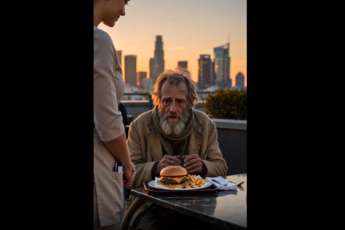
Martin swallowed against a throat that felt lined with dust. Once, he had known how to disappear with dignity. He had worked loading docks, repaired elevators, slept in shelters only when the cold made pride dangerous. But the last year had worn through all that. A fall, an infection, a room he could no longer pay for, and then the streets had done what streets did: they took a man apart quietly, one normal habit at a time. Now he knelt because standing made the world tilt. His khaki coat hung on him in stiff, dirty folds, the cuffs gray with pavement grit. Sunlight cut hard across his face, showing old scars and fresh redness in eyes that had seen too many people decide he was not their concern.
“So thirsty…” he whispered.
No one stopped.
A pair of black trousers passed close enough to brush the air near his shoulder. The owner of them carried a paper cup with ice clicking inside, and Martin’s gaze followed it for one helpless second before shame forced his eyes back to the bottle. He tried to close his fingers around it, but they trembled. The sound of plastic buckling seemed loud to him, though the city swallowed it at once. He thought of the last full glass of water he had drunk: a restroom sink at a train station before a guard told him to move along. That had been yesterday morning. Since then his mouth had become a room without windows.
The brick-red shoes appeared first.
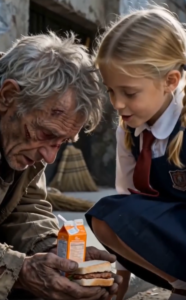
They stepped in from frame right and stopped just inside the hard stripe of sunlight. Small shoes, polished but scuffed at the toes. Martin stared at them because they did not move away. Above them were white socks, a navy skirt, a school shirt tucked in neatly, and a red tie that had been tied too carefully for a child to have done it alone. The girl was six, maybe seven, with blonde hair in two ponytails and a lunch bag hugged against her chest. Her face held the open seriousness of someone who had not yet been trained to look away from suffering.
Martin tried to shift back. “Don’t trouble yourself,” he rasped, though no one had asked him anything.
The girl looked over her shoulder once, perhaps for an adult who was not there, then bent carefully. She balanced with one knee slightly forward, the way children do when they know the ground is dirty but the person before them matters more. Her eyes moved to the empty bottle in his hands. Then, without drama, she opened her lunch bag.
First she took out a small orange milk carton. The label faced inward, unreadable, a bright square of color against the gray sidewalk. She placed it into his open hands, guiding his fingers around it so it would not fall. Then she unwrapped a meat sandwich just enough for him to see the bread and set it carefully across his palm, above the bottle. Crumbs dropped onto his coat. Sunlight caught them like tiny pieces of gold.
“Here, Grandpa,” she said. “You can have mine.”
The word struck him harder than pity would have. Grandpa. Not beggar. Not problem. Not the thing adults stepped around. His fingers closed around the carton with sudden caution, as if it were glass or a bird.
“Your lunch?” he asked.
She nodded. “I already had breakfast. And my mom says water is not enough when people are hungry.”
Behind her, pedestrians continued to pass. One woman slowed, saw the child crouched near him, frowned, and kept walking. A bus sighed at the curb. The broom behind Martin rolled slightly in the wind, its dry bristles whispering against concrete. The girl did not seem to hear any of it. She smiled as if giving away food on a dirty sidewalk were the most ordinary thing in the world.
Martin lifted his face at last. The movement took effort. His neck shook. His red eyes found hers, and for a moment he could not speak because gratitude had come too suddenly, too cleanly, into a life accustomed to refusal. She was small enough that the city should have frightened her, yet she had stepped into his day like someone carrying permission to believe he was still human.
“What’s your name?” he whispered.
“Lily,” she said. “Lily Carter.”
A horn blared. Somewhere a man laughed into a phone. The city did not stop for the exchange, but something inside Martin did. He looked from the orange carton to the sandwich, then back to the child. His mouth trembled around words too large for his dry throat.
“Thank you, Lily Carter.”
She brightened, relieved that he had accepted the gift. “You should drink it now. Slowly.”
He tried to smile and failed. The effort broke something open instead. A tear gathered in the red corner of his eye, heavy with dust, thirst, and the long humiliation of being unseen. It slipped free, cutting a clean track through the dirt on his cheek. Lily watched, not scared, not proud, only quiet.
Martin gripped the carton gently, as if the little box contained more than milk. The sandwich warmed in his other hand. For the first time that day, the noise behind him seemed farther away.
Then a woman called from up the sidewalk, sharp with worry. “Lily!”
The girl turned her head, but did not stand yet. Her smile remained with him one heartbeat longer, brave and small against the rush of the street. Martin lowered his eyes to the food again, knowing nothing about her except her name and everything about the mercy she had given him. The tear reached his jaw.
The frame cut to black before it fell.
Part 2
For years afterward, Martin believed the world had not changed that afternoon; only his place inside it had shifted. The milk did not cure hunger. The sandwich did not give him a home. By evening he was still cold, still ashamed, still a man kneeling too close to the curb with a bottle that had become useful only as a reminder. Yet Lily Carter’s lunch had entered him differently than food. It had disturbed the lie he had begun to accept: that being ignored was the same as being gone.
He drank the carton slowly, exactly as she had told him. He ate half the sandwich and saved the rest under his coat until night, when the wind sharpened between the buildings. Every time he wanted to close his eyes and let the city finish erasing him, he remembered her red shoes planted in the sunlight and the way she had guided his shaking fingers around the carton without flinching. The next morning he walked, unsteady but walking, to a church basement two avenues away. He had passed it many times before. That day he went inside.
Recovery did not look like a miracle. It looked like paperwork. A plastic chair in a crowded office. A volunteer who smelled of coffee. A clinic appointment. A shelter bed. A social worker named Denise who spoke to him as if his answers mattered. Martin fell backward more than once. There were days when thirst was easier than hope because thirst demanded only water, while hope demanded a future. But he kept a small scrap of the orange milk carton, rinsed and flattened, in the pocket of his khaki coat until the print wore away. He did not know why. Perhaps because proof was necessary. Perhaps because, when shame returned, he needed to touch the memory of a child who had not been ashamed of him.
Three winters later, Martin was housed in a room above a laundromat. Five winters later, he repaired broken furniture for a neighborhood nonprofit. By then his hands had steadied enough to hold tools again. He began making small wooden stools, shelves, and toy boxes from discarded boards, sanding each piece until the splinters no longer threatened anyone. The work was slow, but it put him back into conversation with the world. People learned his name. Children from nearby schools painted the shelves for charity drives. Whenever he saw a little girl in red shoes, he searched her face, though he knew time would already have changed Lily Carter into someone he might not recognize.
He never found her.
But kindness has its own way of traveling without asking permission. Martin started carrying two bottles of water in summer, one for himself and one for whoever needed it more. On cold mornings he kept extra sandwiches wrapped in wax paper. He told no one why. When people thanked him, he only said, “Someone fed me once.”
Twenty years after the afternoon at the curb, the old wall still stood, though the bakery beside it had become a glass-fronted office. The bamboo broom was gone. The traffic had grown louder, the sidewalk busier, the suits sharper. Martin, now known around the block as Mr. Vale, no longer knelt there. He walked with a cane and kept his beard trimmed. His coat was still plain, but clean. In his hand he carried a brown paper bag containing two sandwiches and a carton of orange milk.
He had come because the date lived in him.
Near the same curb, a woman stood arguing softly into her phone while holding a little boy’s backpack. She wore a dark work coat, tired eyes, and brick-red flats. Martin might have passed her if the light had not caught her face at a particular angle, revealing the child she had been under the years she had survived. The ponytails were gone. The red tie was gone. But the eyes were the same: bright, serious, unable to look away for long from pain.
“Lily Carter?” he asked.
The woman ended her call slowly. Caution came first. Then confusion. “I’m sorry, do I know you?”
Martin held the paper bag against his chest. For a moment he was back on his knees, thirsty and ashamed, looking up at a child who called him Grandpa. “You gave me your lunch once,” he said. “Right here. Orange milk and a sandwich. I was holding an empty bottle.”
Her face changed before she spoke. The memory arrived in pieces: the dirty coat, the bottle, her mother’s frightened voice, the old man’s tear. Lily covered her mouth with one hand. “That was you?”
He nodded. “That was me.”
The boy beside her looked between them, puzzled. Martin crouched as far as his cane allowed and offered the bag to him. “Your mother saved my life,” he said. “Not all at once. But enough for the next hour. Sometimes the next hour is the whole battle.”
Lily’s eyes filled. “I thought about you for years,” she said. “My mom was angry that day. She said I could have been hurt. But I kept wondering if you found water.”
Martin laughed softly, and the laugh broke into something close to a sob. “I found more than water.”
The city moved around them just as it had before. Cars blurred behind the curb. Pedestrians glanced and continued. The afternoon sun cut across the pavement, harsh and honest. Lily took the bag with both hands, the same respect she had once shown him. Her son watched her, learning silently from the shape of her face.
“I became a teacher,” she said. “First grade. I tell them to notice people. Some days I wonder if that is enough.”
Martin looked at the boy, then at the sidewalk where he had once knelt. “It was enough for me.”
Another tear slipped down his cheek, slower now, less bitter than the first. Lily stepped forward and placed her hand over his, not as a child comforting a stranger, but as a woman receiving the life her own kindness had helped return. There was no music in the real street, only engines, footsteps, wind, and the plastic rustle of the bag between them. Still, the moment held.
Martin did not tell her every dark thing she had interrupted. He did not need to. She did not ask for proof that her lunch had mattered. Some truths stand quietly between people and breathe.
When the traffic light changed, Lily’s son tugged her sleeve. “Mom,” he asked, “can we buy extra sandwiches today?”
Lily looked at Martin. He looked back, smiling through wet eyes.
The frame lingered on the three of them beside the curb, the orange carton visible at the top of the paper bag, the old scarred bottle of the past nowhere in sight except in memory. Then the city swallowed the sound, and the screen faded before anyone answered.