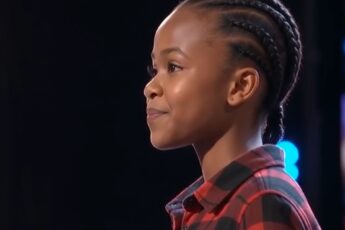
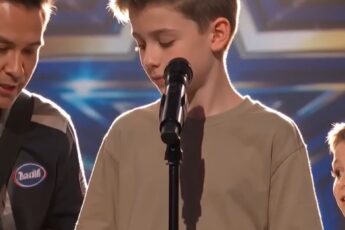
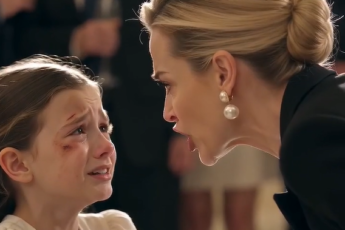
Some kids have an imaginary friend. On the Got Talent stage, one child’s imaginary friend had opinions about the judges.
The kid walks out, introduces the invisible companion, and the friend starts rejecting people. “She likes you. She wants to play with you. She doesn’t like being rejected.” The child shakes their head. “No. No. No.” The audience laughs, then stops. The friend is a presence the performer cannot fully control, and the child’s deadpan delivery makes it worse.
The Invisible Performer
A different act takes the stage with a different problem. The performer tells the judges, “You can’t see me. You’ll never see me, but I am back.” Then the real trick begins. A judge is made invisible. The performer walks them to a desk, has them focus on a candle, and tells them to look at the other judges. “You can see them, but they can’t see you.”
The invisible judge is asked to read Simon Cowell’s mind. The performer asks, “Please tell Simon how many fingers he is holding up.” The invisible judge says, “Simon, you’re holding up seven fingers.” Then the time: “12:15PM.” Simon looks at his watch. The audience goes quiet.
Between the Dark and the Light
Another performer opens with a question that hangs over the stage: “Between the dark and the light, the good and the evil, which will you choose?” The act involves two pathways, an apple, and a judge named David who takes a bite. Then Alicia’s turn. “Take it, asshole. Fighty fight.” The judge’s casual energy clashes with the performer’s gothic delivery.
The performer pulls Amanda to the center. “Your hands out. Face up. Come closer.” Amanda’s hands are held up, and the performer says, “Your destiny will be chosen by another.” The audience holds its breath. “Left or right?” Amanda whispers. “Louder.” “Right.” “Who’s right? Louder? My right.” She bites the apple.
Then the line that lands: “Amanda, you know why they say beauty’s only skin deep? Because we’re all rotten to the core.” The performer’s face changes. The witch on stage turns into a cockroach. David says, “I was scared to death.” Alicia calls the act “brilliant.” The vote is four yeses.
The Arsonist
The most unsettling act in the collection involves a bell. The performer tells a judge named Terry, “Take this bell in your right hand. You are our witness tonight. And for Sofia’s safety, do not ring the bell at all.” Terry grips the bell. “Don’t ring the bell. Oh god.”
The performer tells a story. “The people I’m about to introduce to you are united by one important factor. They all perished in a horrifying hotel fire precisely one hundred ten years ago.” Sofia is asked to flip through photographs and stop when she feels compelled to. She stops. The performer slides the picture out. “Her name was Lucy, and she was the only one who did not die in the blaze.” A pause. “She was the arsonist.”
Terry’s hand moves. The bell rings. “I didn’t ring it. I’m not ringing it. I didn’t do that. She’s here.” The performer has not touched the bell. The audience has not touched the bell. Terry’s hand moved on its own, or so it appears, and the sound cuts through the studio like a crack in a window.
Agatha Turner, 1860
A performer named Elizabeth takes the stage on Britain’s Got Talent. She references Houdini, who in 1919 appeared at London’s West End theaters and offered a large cash sum to anyone who could prove ghosts existed. “It is said to be good luck to see ghosts for a performer. For others, not so much.”
She hands Amanda a journal over a hundred years old. Then she asks Amanda to count photographs face down onto a table, one at a time. “When you place them down, you’re going to feel a connection to one. When you feel that connection, I want you to stop and place that photograph face down into this cigar box.”
Amanda stops. She pulls the photograph from the box. “Agatha Turner 1860.” Elizabeth tells Amanda to open the journal to a bookmarked page and read the circled paragraph. “Miss Turner was born in the eighteen hundreds. She loved visiting the West End to be entertained. She tragically died in 1860, and her ghost is said to haunt the theaters that she once loved.”
Elizabeth says, “Amanda, this moment was always meant to be. Look over your left shoulder.” Amanda turns. Something is there. The audience gasps. “Oh my god.”
The Forest of Haunts
The next act involves balloons and a judge who keeps saying he wants to go home. “I hate this creepy stuff, man. Don’t play.” The performer calls the setup the “Forest of Haunts.” Simon is asked to choose two numbers. He picks one and two. The balloons are opened. One contains blood. “What is it? Blood? It’s blood.”
Simon is given a choice. He picks a balloon. The performer says, “Simon has pulled off saving Sofia’s head. This is the balloon he didn’t choose.” The other balloon is opened. A maggot falls out. “Don’t do that. It’s a little maggot. Why are you touching it? That could have been in your hair.”
The Chalkboard
The last performance brings back the imaginary friend. A performer named Mike works with a judge whose friend is called Desmond. “He’s my spirit energy that I’ve sort of had a little communication with throughout my life. They say I’m crazy.” Mike holds up a piece of chalk. “I’m using chalkboards. That way you know it’s analog. There’s no digital electronics. Nothing like that.”
The judge holds the chalk and thinks of someone with an emotional connection. “Just the first name. Somebody I couldn’t possibly know.” Mike places the chalk on a blank board. The chalk moves. A name appears on the board that no one on stage wrote.
The Got Talent stage is a strange place for magic. The audience expects a trick, a reveal, a clean ending. These performers give them something else. A child’s friend who rejects you. A bell that rings when it shouldn’t. A photograph from 1860 that was “always meant to be.” A maggot in a balloon you didn’t pick. The tricks work because they refuse to be clean. They leave a residue, a feeling that the stage is not quite empty when the performer walks off.
Watch the full video to see every act in sequence, from the child’s imaginary friend to the chalkboard that writes itself. The scares build on each other, and by the end, the studio audience is not clapping so much as exhaling.