The bright lights of a talent stage often demand technical perfection, but the most memorable moments frequently arise from pure, unadulterated chaos. While many contestants arrive with polished routines and rehearsed jokes, others arrive to dismantle the very idea of a standard audition. They turn the stage into a theater of the absurd, where the goal is not just to show skill, but to catch the judges completely off guard.
The Audacity of Sonny Chatham
Sonny Chatham arrived from Paris, Texas, with a ukulele and a dream board. He did not just want to sing; he wanted to command the room. His first move was to present a board featuring Sofia Vergara, claiming he had a “lady friend” named Pete who was busy taking care of her mother. The judges watched as he navigated the stage with a level of confidence that bordered on the absurd. He insisted on choosing his own song, presenting a stack of pink cards and demanding the judges pick a love song. The tension in the room was palpable as the judges threatened to hit the red buzzer, but Sonny remained undeterred. He turned what could have been an annoying encounter into a moment of genuine connection, leaving the judges to admit that he had gone from being the most annoying contestant they had ever met to someone they actually wanted to see again.
The Comedy of Errors
For some, the goal is to blend humor with music. Emily Bland, a 29-year-old front desk clerk from Northeast Arkansas, walked onto the stage with a comedic edge. She leaned into the cultural zeitgeist, joking that her mother was a “Karen.” While the judges initially expected a standard comedy set, Emily pivoted to singing, proving she could handle both the punchline and the melody. It was a calculated risk that highlighted the thin line between a comedian and a singer, proving that a good joke can be the perfect setup for a song.
The Illusion of the Duo
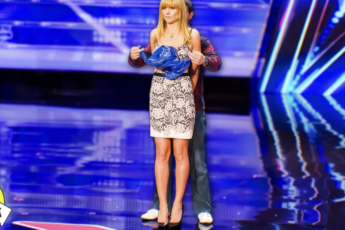
The concept of a musical duo was completely redefined by a ventriloquist who mastered the art of improvisational lip-syncing. The performance began with a man singing with uncanny precision, his eyes locked on the woman beside him. The judges were visibly confused, questioning if the woman was actually the one singing. The reveal was sudden and surreal: the woman was a puppet. The act relied on the ability to react to the unexpected, turning a simple vocal performance into a complex game of deception that left the judges questioning their own senses. It was a masterclass in how to use a gimmick to create a moment of genuine surprise.
The Canadian Kid and the April Fools Twist
Remy Smith, a 10-year-old from Canada, delivered a performance that felt almost too polished to be real. He leaned heavily into Canadian stereotypes, joking about shoveling snow, skating, and the necessity of apologizing. He spoke of the relatable struggles of childhood, such as failing math tests and upcoming dentist appointments. He even joked about the mess in his room, claiming everything was hidden in a single pile of clothes on the floor. The audience was captivated by his timing, but the true performance was the reveal. Remy was not a comedian; he was an actor. The entire set was a carefully constructed April Fools’ joke, proving that even a child can master the art of the long con.
A Dog with Ambition
In one of the more surreal segments, a woman named Michelle introduced her best friend, Mouse. Mouse is a dog with aspirations of becoming a model, specifically compared to Kate Moss. The performance took an unexpected turn when Mouse appeared to sing, leaving the judges to wonder if they were witnessing a miracle or a trick. The absurdity of a dog singing an Alicia Keys song provided a moment of levity that broke the tension of the competition. When asked what he would do with the prize money, the joke was that Mouse would use it to get himself a new pair of hips.
The Chaos of the Prank
The stage is often a place for high-stakes drama, but it is also a playground for pranks. Marty Cutts, a Canadian performer, brought a different kind of energy to the stage. His act involved a level of messiness that caught the judges off guard, turning a standard audition into a chaotic spectacle. Whether it was a magic trick gone wrong or a planned disruption, these moments remind us that the most entertaining part of a talent show is often the part that goes off-script. From pie-throwing chaos to magic tricks that fail in real-time, the unpredictability is what keeps the audience watching.
These performers remind us that talent is not always about technical perfection. Sometimes, it is about the ability to surprise, to joke, and to embrace the messiness of a live performance. As the competition continues, the question remains: who will be the next to break the rules and leave the judges speechless?